The Machine Stops
THE MACHINE STOPS connects artists
Clare Mitten, Adam Hogarth and
Gabriela Schutz with composer
Martin Ward in an attempt to understand the way that technology and the screen increasingly mediate the contemporary experience.
These artists share a fascination with the technological - an excitement and curiosity about where it may take us, tempered, however, with an increasing disquiet as our reliance on the hi-tech escalates. Information and knowledge appear to be our new religion. Infinite data is accessible through our fingertips; smart machines allow us direct experience through the virtual, manipulating and examining data; allowing us to view and understand our world in new ways; while on some levels, paradoxically distancing us from engaging with the physical world.
The title of the exhibition is taken from E.M. Forster’s short story from 1909, about a world where people live below ground in isolation, with all needs met by the Machine. Physical connection between people is permitted but rarely done. Communication is made via the Speaking Apparatus - a kind of instant messaging, video conferencing machine, through which humans exchange ideas and knowledge.
A century after the story was written, in similar times of apparently radical technological change, the machine never stops. We are dazzled yet apprehensive of where technology might lead us, and nostalgically yearn to retreat occasionally to the known past. What happens when you stop, stilling time to capture a moment from the continuum and then explode it, exploring a tiny fragment from the relentless stream of information?
Schutz is preoccupied with the vast time we are spending on our phones; physically being somewhere yet mentally being elsewhere. Her work depicts emotional moment as seen through the screen and social media sites.
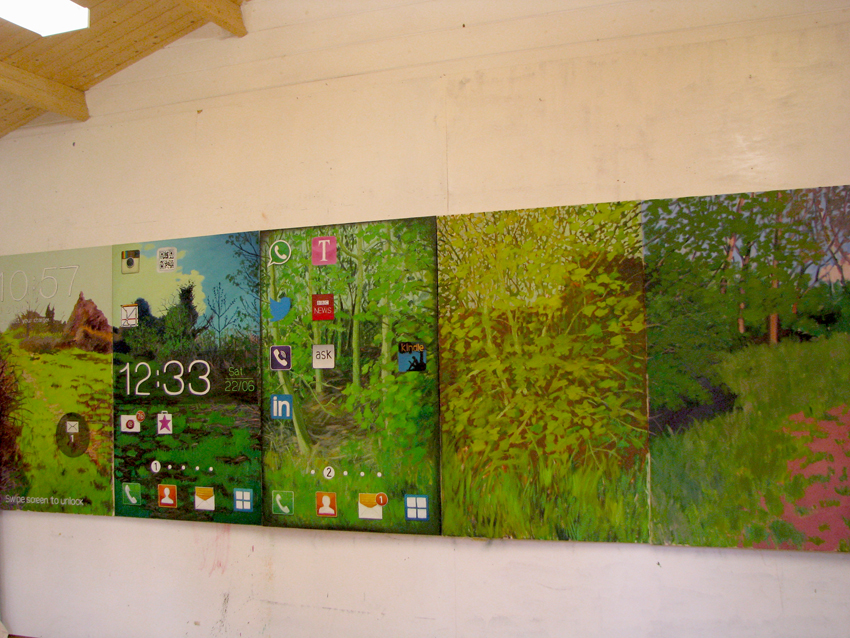
‘Where We First Kissed’ (Unfinished) presents the different screens on the smartphone, each tinted in different ‘Instagram’ effect.

'Like, Comment, Share', a scroll of Facebook posts with their feedbacks gives permanence and tangibility to what would have been out of sight and mind.

‘Tweet! Tweet!' (Etching on paper) will involve the participation of the visitors, and will transform the digital Facebook into an analogue and physical experience.
Mitten’s painterly constructions from cardboard and paper, present a mock world of technological and mechanical innovation. The whirring and ticking of reinvented machines (hybrids of time-marking, image-capturing, information processing devices) is paused, awaiting reactivation by the viewer. The overlaps between objects and how they are made creates junctions that re-boot the circuit. It takes us back to the surface of things in the physical world, through the rips, smudges and stains of the handmade, which flicks like a switch between the real and the imaginary.

‘Counter Clean’, Clare Mitten

‘YMMF’, Clare Mitten

‘AZTEC’, Calre Mitten
Adam Hogarth looks into the impact that online communication is having upon language. With words like ‘Selfie’ making entries for the 2013 Oxford English Dictionary it is clear that ‘Textspeak’ has moved beyond the confinement of a computer screen or social networking site. He believes that the condensing of language through abbreviation (LOL, etc), portmanteau (emoticon, bromance, etc) and numeronyms (gr8, b4, etc) is having a negative effect on written language, which reduces the potential for expression. For this show Hogarth works on a series of 20 etchings where he copies meticulously by hand William Morris’ designs, to form backgrounds with selected examples of online discourse aquatinted in the foreground. He uses William Morris as a point of reference because of his attitude towards the preservation of a creative legacy and the home- made object, that Hogarth applies to language within the modern age.

Adam Hogarth

‘FAKE LULZ’ Adam Hogath

Adam Hogarth
Ward is composing a new work ‘Touch-Screen’ using field recordings and composed elements to delve into the clicks and beeps; the ringtones; recorded messages and verbal interactions which accompany our everyday lives, and combining these with musical reaction, Ward seeks to explore the dichotomy, both real and symbolic, between two seemingly divergent means of communication: human ‘Touch’ and technological ‘Screen’.
The work will be delivered as a performance piece and as an interactive soundscape in which the varying elements can be explored and recombined by the visitors.
The Machine Stops aims to suspend a moment within the gallery space, where the soundscape will ruffle and disturb the quietness of the artworks, reactivate them, complete them. The exhibition will provide the visitors an environment in which to meditate and consider technology within their own lives, but also to create a tangible experience as appose to the virtual one.
The works for this project are all being done as a response to collaborative discussions, a sort of a musical dialogue. It is an attempt to defy the detachment our society may find itself in.